

One of the best music memoirs you'll read this year
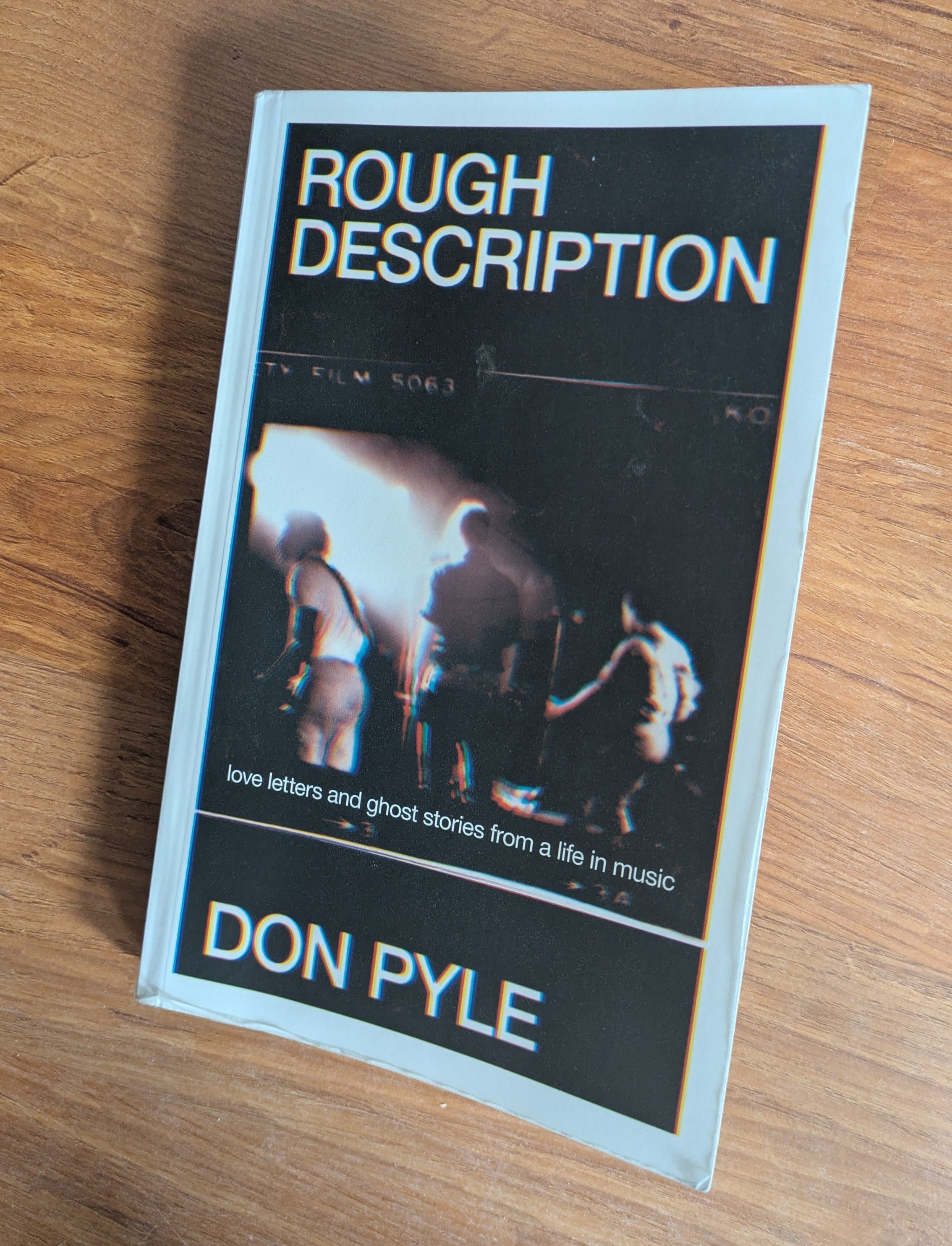
Digging into Don Pyle's new book 'Rough Description: Love Letters and Ghost Stories from a Life in Music'

On an unusually warm spring evening, I packed into a hot, stuffy room to listen to Don Pyle share from his new book Rough Description. There was a steady line-up at the bar as the overheated crowd thirsted for white wine and beer.
I spotted writers, and musicians, and DJs throughout the audience. When Don read out the title of one the book’s chapters, “That Time I was a Gay Hairstylist,” several people whooped in what I assumed was collegial familiarity. The book launch had opened with readings by poets and journalists: Kirby, Tabatha Southey, Jason McBride, Chris Colohan. Damian Rogers moderated a discussion with Don later into the night.
Each person in the supporting line-up is a hybrid artist, crossing over into different genres or creative arenas. I met Damian, for example, when she was an editor at Toronto’s now defunct alt-weekly Eye Magazine. I was freelancing for her at the time, but our paths have kept us connected as we both also write poetry.
This collection of people who follow ideas rather than genres is reflective of Don’s career. Perhaps best known as the drummer in Shadowy Men on a Shadowy Planet (who brought us the Kids in the Hall theme song, “Having an Average Weekend”), Don’s creative roots go back to photography when he started taking pictures of the early Toronto punk scene in the 1970s.
But Don has also been in a number of other bands, including Crash Kills Five, King Cobb Steelie, Long Branch, and Phono-Comb. He’s worked as a producer and made music for film.
Don is, on top of everything else, an incredible writer. His new book, Rough Description, is one of the best books I’ve read in 2026. It’s not Don’s first foray into writing: He’s written about music and more for years, and released the wonderful photo-essay memoir Trouble in the Camera Club in 2011.
But this book has a very different structure than its predecessor. Rough Description unfolds essay-style, taking circuitous, non-linear routes through various angles and eras of Don’s life. In one chapter we are on the road with Shadowy Men, in another we are getting a behind the scenes look at what it was like to go to hair dressing school. (Hint: It was remarkably eventful.)
Don states that he set up the chapters like a set list, rather than chronological. The results take the reader on a spiral journey, mimicking the rhythm of memory. The reader weaves through a range of landscapes, from Toronto’s early punk scene, to Crash Kills Five’s rehearsal spaces, to Don’s childhood home and so much more.
One of the things I appreciate the most about this book is that it doesn’t shy away from its Canadian-ness. While there can be a temptation for Canadian writers to play to an international (read: U.S.) audience by trimming or dimming down Canadian references, Rough Description embraces them wholesale. There are specific pop culture markers that filter through generational memory, like Don’s reminiscence of the CBC’s The Big Friendly Giant, which ran from 1958 to 1985 – an astounding length of time that today’s viral-quick culture can’t withstand.
Even Don’s drumming looms large in my memories of growing up watching MuchMusic for hours (VideoFlow, anyone?) on which Shadowy Men would frequently be slotted: the band’s short songs fit perfectly into weird gaps between programming, when the station had a quick moment to fill.
And while Kids in the Hall was known outside of Canada, Don remarks of “Having an Average Weekend” that, “It’s definitely a song many people know and identify with us, but I think the Fabricland or Pizza Pizza jingles are dug far deeper into people’s brains.”
One of the most skillful things about this book is that it holds these Canadian specificities close, but the writing never feels insular or isolating. Many of Don’s essays are intensely personal – I was mesmerized by the level of vulnerability they convey. And yet this can also sometimes isolate readers of memoir, as authors can overstate the importance of something, or become obsessed with their own voice.
Yet Don’s writing transcends the common trappings of autobiography. One of the reasons for this is that he takes his stories into places many of us have unfortunately been to when it comes to the challenges that music and artistic scenes present – even though they can often begin with the intentions of being progressive spaces.
In the chapter titled “The Beginning,” Don writes about the growing division he noticed as punk attracted more aggression and moved away from its earlier roots:
“So many gays had been involved at the beginning of punk. For half the people that started the scene, it was an art movement, and a revolution of radically restructuring music norms. For others, it was the menace, intensity, speed, and dumb thrills that were most electrifying. I was living both sides of this divide. The black leather, aggressive, and heavy punk was homophobic; coming out didn’t feel safe.”
There is also a strong thread throughout the book that speaks to the misogyny that exists in music scenes – and can be especially evident in certain punk spaces, though not exclusively. As a woman who’s been involved in music since I was a young teen, I particularly appreciated Don’s articulation of certain factors that can be present in male-dominated spaces – especially ones that, again, purport to be forward-thinking, but that often end up doing the opposite.
“As much as I love men, I get kind of creeped out when a band’s audience is almost entirely male,” Don writes in “Dumb/Smart.”
Yet there is an undeniable humour throughout the book as well: Don is incredibly funny. One of my favourite passages is when he describes a rehearsal space that Crash Kills Five used in a quirky old factory in downtown Toronto, which was shared by other artists who weren’t crazy about the noise a band would create.
“Angriest of all was the mime school that was our closest neighbour,” Don writes in “The Beginning.” “Everyday outraged mimes would come and yell at us, and we’d reply with a silent finger to our lips. We didn’t make any friends there.”
Notably, Don’s humour never feels dismissive, and it never feels out of step with the poignancy so much of this book captures. I kept thinking of the old SNL joke as I read it: “I laughed! I cried!”
Because I did: Rough Description takes the reader to so many places. Sometimes it feels like a love letter to a Toronto that no longer exists; the book easily transports us back to spacious lofts and barren downtown streets.
The book also introduces us to so many people who can no longer tell their own stories: Reid Diamond, Dallas Good, Don’s mother, Shirl.
And it is a reminder that art is influenced by the conditions it comes out of. Don is of a time when there was great freedom to explore and invent, when a city like Toronto was half empty and no one cared about the value of its real estate yet. We meet others, through Don’s eyes, who also operated through these conditions and made their own creative contributions.
Rough Description is an incredible document, a deeply personal collage of a unique career that grew amongst some of the most remarkable decades in music, television, media, and more. It stands on its own as a memoir, incomparable in its approach and structure.
As cliché as it sounds, there is something in this book for everyone: Read it expecting to be immersed and moved.
—
Rough Description is available through ECW Press.
I loved this review almost as much as I loved the book!