

Square those shoulder pads!
Touching on the life and legacy of Rough Trade frontwoman Carole Pope

When Rough Trade was invited to open for David Bowie’s 1983 Serious Moonlight tour, it was the kind of opportunity that could catapult a band’s career to new heights.
Touring at that level is an investment, especially internationally. It requires visas and a traveling crew; staging and lighting; and more. The Toronto band were doing quite well in ‘83.
Their single “All Touch,” off of For Those Who Think Young, was charting in Canada, the U.S., and Australia; it would become of the band’s most successful songs. Singer and founding member Carole Pope also beat out Joni Mitchell at the Junos that same year for best female vocal.
Rough Trade, formed in Toronto by Pope and Kevan Staples, got their start in the late 1960s, but they were made for the ‘80s. Campy, bold, glamorous, and smart, they offered the perfect mix of cerebral sexuality and catchy songwriting. They were avant garde and theatrical, though it’s the latter that helped make them feel accessible: Pope played to the audience, inviting listeners into her sensual world, making them feel like they were being let in on a very juicy secret.
It’s no surprise Bowie was intrigued: Here was a band with a vision, where fashion and self-expression as much a part of the experience as the songs themselves. When Rough Trade opened for him in Toronto
on the Serious Moonlight tour, it led to the invitation to continue on internationally – something Rough Trade needed help to finance.
While it seems like it would have been a great investment, Columbia Records declined the band’s request for tour support, dashing the opportunity.
It’s a mind-boggling moment to consider not only in the history of Rough Trade, but in Canadian music on a whole. There are countless stories of bands that have come within inches of breaking out, only to be blocked by circumstances outside of their reach. Sometimes it’s lack of industry support. Other times it’s a label or distributor bankruptcy, or poor mismanagement.
It makes you wonder about the domino effect of it all: If a band like Rough Trade had been able to take Bowie up on his offer, and succeeded as a result, would it have opened more doors for other Canadian artists to hear a “yes” instead of a “no”?
At this point, we can only look back and wonder “what if,” which is another common prerogative when talking about Canadian music history.
Yet Rough Trade’s story, and the momentum behind them – regardless of the circumstances that may have unfortunately slowed things down – is fascinating. And now, the band’s work and legacy have finally been captured on film thanks to Michelle Mama’s 2026 documentary Antidiva: The Carole Pope Confessions.
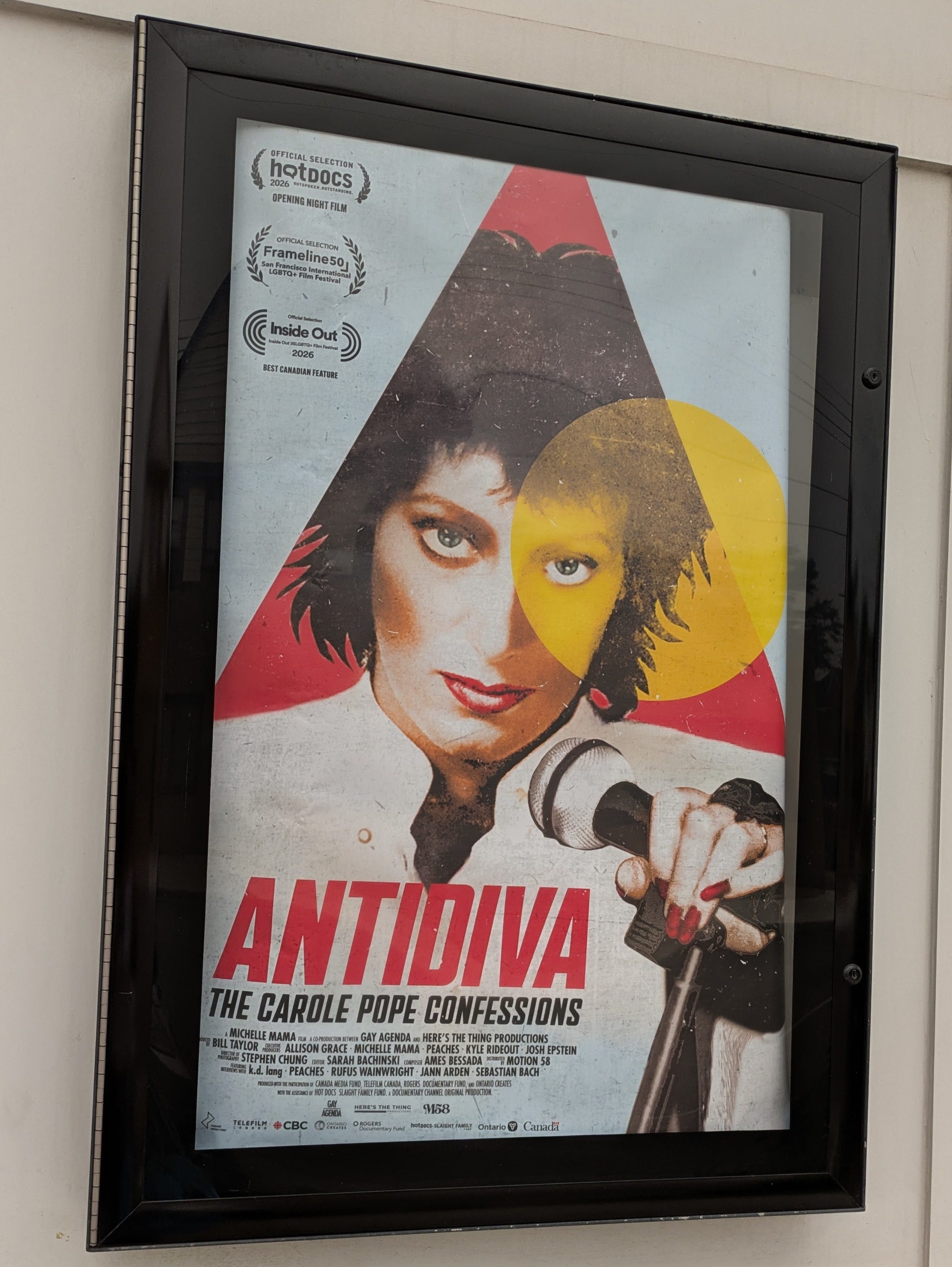
The story of Pope and Rough Trade is a big one. Pope is a deeply important figure in Canada, and beyond. “There are a lot of people standing on the shoulders of Carole Pope and they don’t even know it,” remarks Canadian media personality George Stroumboulopoulos, who appears frequently throughout the film to provide commentary and context.
Not only is Pope incomparable as a performer – there’s truly no one like her in Canada – but she and Staples broke down many doors for music and culture that came later. Ahead of their time, Rough Trade were subverting the stage long before movements like punk.
They were experimenting with image and sexuality, especially women’s sexuality. While Pope and Staples started off as a couple, Pope later came out as a lesbian, also at a time when public acceptance of gay culture wasn’t yet where it’s at today.
Cultural shifts have always relied on people like Carole Pope, who fearlessly move forward regardless of the barriers that they may encounter along the way. And again, Rough Trade reached impressive heights in the ‘80s, and are still remembered and celebrated by many today. Antidiva offers a star-studded roster of interviews with the likes of Peaches, Sebastian Bach, k.d. lang, and more.
The film weaves between the highs and lows of Pope’s career. The highs are evident in the impact of a songwriter who is all-in on her music: Many times, Pope emphasizes that her art is what matters most. Even when she was offered to go solo for Motown, she declined when it meant she wouldn’t be performing her own material.
“It’s not always about money,” she explains. At some points, the film feels like an artist’s manifesto, a call to stay true to yourself and your vision no matter how tempting some detours may look.
There are several times when Pope talks about the costs of committing to one’s art, describing herself as a “struggling musician” in spite of the band’s past success. The film opens in Pope’s Los Angeles apartment, a small, spartan space. Later, we see her storage locker, which houses her platinum records and awards.
Still, Pope remains sought after. The film frequently follows her to live gigs, where fans talk to the camera about how much her music means to them. They are of all ages; Pope has transcended generational divides, but even that feels tenuous at this moment time, with digital cultural accelerating trends.
“In order to make a living, I have to play live,” she says. “We have made some money from royalties but that’s not now.”
Why? One reason is that when vinyl fell out of popularity, things changed: Rough Trade’s albums weren’t released on CD. This might sound like a negligible detail these days, as physical media (though rising in popularity) is still seen largely as a niche thing to collect. While the CD’s moment in the mainstream feels short in hindsight, it led to significant royalty gaps for artists whose labels didn’t invest in making the transition for their artists, or that had folded by the time the CD’s star was rising.
Pope’s career has been long. It carries on today, which is one thing that makes Antidiva such an interesting film: It’s a multi-decade study of Pope’s trajectory, a time capsule containing six decades of immense musical and cultural change. We get a history lesson in queer culture and a glimpse into a Toronto of the past. We see the highlights of an era when the convergence of art, music, and fashion was at its peak.
And we get an inspiring look into what it means to make art without apology.
Packed with archival footage and sharp commentary, Antidiva is an important, long overdue document of a Canadian artist whose influence is immeasurable.